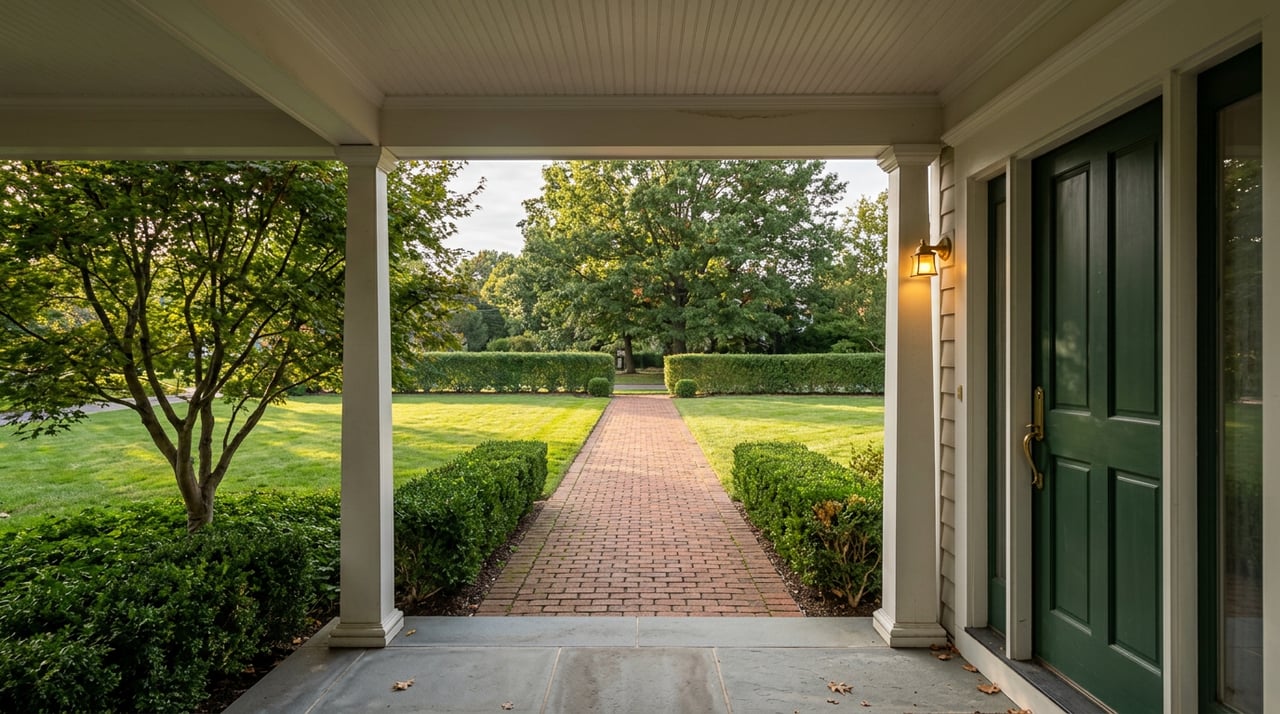
What Your Budget Buys in Tenafly NJ Real Estate
Search "Tenafly median home price" and you will get three different answers depending on which site you land on and which month it last updated. One will show a sale price near $1.5 million. Another will show $1.71 million. A third will show asking prices down double digits from a year ago. None of these numbers are wrong. They are measuring different slices of a market that no longer behaves like one market.
That distinction matters if you are actually trying to bid on a house here, because the number you anchor to determines whether your offer looks competitive or delusional.
Over the three months ending May 2026, Tenafly's median sale price sat at about $1.5 million, up 2.9 percent from the same period the year before. The median price per square foot for that window was $603, up 8.7 percent year over year. Homes were selling in 76 days on average, down slightly from 80 the year prior, with 27 closings in May 2026 compared with 37 the May before.
Zoom into a single later month and the picture shifts. In July 2026, homes that closed in Tenafly sold for a median of $1.71 million, with 49 sales that month against 38 a year earlier, and days on market stretched to 30 versus 23. Meanwhile, the homes actively listed for sale in August 2026 carried a median asking price of about $1.65 million, down 17 percent from both July 2025 and August 2025.
Put those three data points next to each other and you get a market that is simultaneously appreciating on a rolling basis, spiking in individual months, and pulling back on what sellers are willing to ask. That is not a contradiction to explain away. It is the signature of a small, thinly traded market where a handful of high-end closings in any given month can swing the median by hundreds of thousands of dollars, while the broader pool of sellers testing the market with a new listing is pricing more conservatively than the headline suggests.
The reason no single median can describe this borough honestly is that Tenafly is really three adjacent markets sharing one zip code.
| Tier | Rough Price Band | Character |
|---|---|---|
| East Hill | $3M and up | Larger lots, estate-scaled colonials and newer construction, slower to trade, more room to negotiate on price and terms |
| West Hill / Riverdale | roughly $1M to $2.5M | Established colonials and capes, the bulk of move-up buyer competition |
| Smith Hill / downtown | roughly $900K to $1.5M | The walkable entry tier, smaller footprints, closest to Washington Street and the train station site |
A buyer with a $1.2 million budget and a buyer with a $3.5 million budget are not competing for the same houses, seeing the same days-on-market, or facing the same negotiating dynamic, even though both will see the same borough-wide median quoted back to them by a portal.
The reason price per square foot and headline median move at such different speeds traces back to when this borough was actually built. Census-derived housing age data puts Tenafly's median construction year at 1958, and roughly a quarter of the housing stock predates 1940. Most of the rest went up during the Cape and ranch boom that followed the GI Bill and the postwar opening of the Palisades Interstate Parkway, which shifted commuting from rail to car and turned the borough into a driving suburb almost overnight.
That means a large share of what is on the market at any given time is a modest, mid-century footprint on a good lot. When one of those lots trades as a teardown and a buyer replaces it with a larger, current-code rebuild, the price per square foot on that closing can be dramatically higher than the ranch it replaced, even in the same neighborhood. Enough of those transactions happening in a short window is exactly what produces a price-per-square-foot growth rate that outruns the median. The lot hasn't changed. The product that closed on it has.
The downtown tier's trajectory is not theoretical. The old Tenafly Cinema, a movie house that first opened under a different name in the 1920s and operated most recently as a Bow Tie Cinemas location, sat dark after closing during the pandemic. In April 2025, Ariel Property Advisors arranged a $5.2 million construction loan for developer Bergen Pro Builders to redevelop the 4.5 to 5 W. Railroad Avenue site into a 20,000-square-foot mixed-use building with two ground-floor retail spaces and 18 residential apartments, three of them designated affordable. The financing team highlighted the project's transit-oriented positioning, with 11 covered parking spots equipped with EV chargers, directly across from where the old rail line still runs.
That building will add renters, not buyers, to the downtown footprint. But it is exactly the kind of foot traffic and full-time resident base that supports the walkable-downtown premium already priced into the Smith Hill tier. If you are weighing a smaller downtown-adjacent home partly because of what downtown might become, this is the clearest evidence yet that it is actually becoming something.
Not every downtown project is moving at that pace. The 123-145 Dean Drive Redevelopment Plan, which envisioned either assisted living or hotel development on the site of the Clinton Inn, hit a real snag when the hotel property changed ownership in 2025. Because the plan required unified ownership across the parcels involved, the borough council acknowledged the sale raised open questions about whether the new owner is even bound by the existing redevelopment terms. As of the Mayor and Council's spring 2026 budget session, updates to that plan were still being introduced rather than finalized.
Set next to the cinema site's clean path from financing to construction, Dean Drive is a reminder that downtown momentum in Tenafly is uneven. One corner of Railroad Avenue is actively adding units. Another, a few blocks over, has been in some form of redevelopment limbo for years. If your reason for choosing Tenafly is the walkable downtown itself, it is worth knowing which projects are financed and moving and which are still working through ownership questions.
None of this means the portal median is useless. It means the borough-wide figure is a starting point, not a comp. Tenafly has not had passenger rail service since the 1960s, and the former Northern Branch corridor still functions as a defining downtown feature even without trains running on it, which is part of why the walkable, bus-served downtown tier commands the premium it does relative to homes further from Washington Street. For context on scale, single-family homes across Bergen County broadly were trading in the $835,000 range for much of 2026, which puts Tenafly's downtown entry tier at a real but not enormous premium over the county, while East Hill sits in an entirely different price universe.
The practical takeaway is simple. Before you anchor an offer to last year's sale price for a home that looks similar to yours, confirm you are comparing the same product: same era of construction, same tier, same rough footprint, not a rebuild that happened to land on a comparable lot.
Should I wait for the downtown redevelopment projects to finish before buying? Both the cinema conversion and the Dean Drive site are multi-year projects. They will shape downtown's character and rental base over time, not this year's sale comps. If your reason for being in Tenafly is the schools, the commute, or the housing stock itself, there is little upside to waiting on construction timelines you cannot control.
Is the entry tier still competitive? Based on the pattern in the data through mid-2026, well-priced homes in the $1 million to $2.5 million range have continued to draw faster activity than the $3 million-plus tier, which trades more slowly and leaves more room for negotiation on price and terms.
If you are trying to figure out which Tenafly tier actually matches your budget, or whether a specific comp is telling you something real, Tony J Lee can walk through the numbers with you street by street. Let's Connect.
Stay up to date on the latest real estate trends.
Whether you’re buying your first home, selling a trust property, or navigating a probate sale, my goal is always the same: to provide honest guidance, strong advocacy, and a smooth experience from beginning to end. Real estate is about people, not just properties. I would be honored to help you take your next step.